
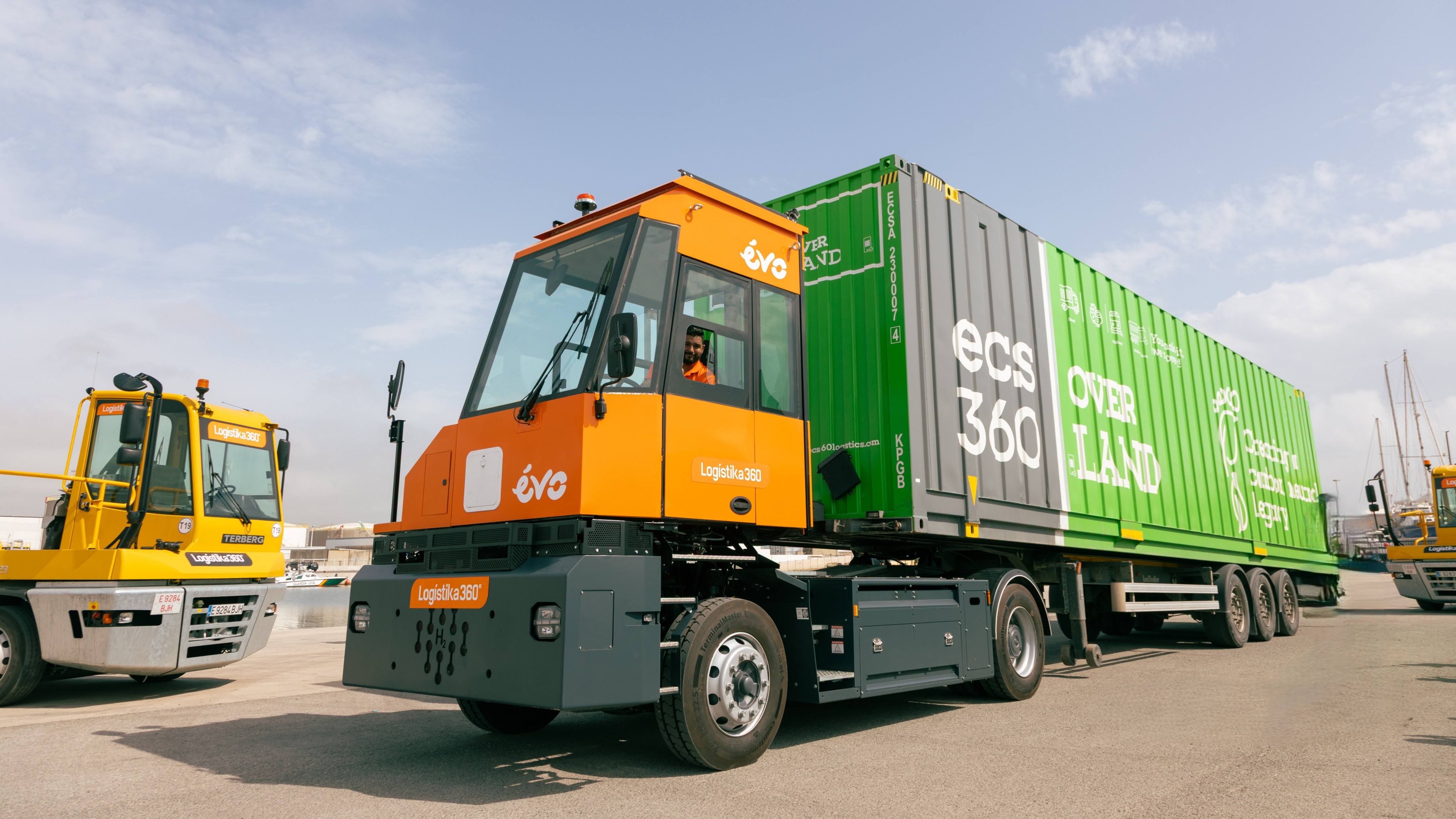
EVO’s H2Tractor, powered by a hydrogen fuel cell, is being integrated into the Logístika 360 fleet to test its performance in real-world working conditions.
On Tuesday 28 April, the Port of Algeciras hosted the start of real-world trials of EVO’s H2Tractor, which has been integrated into the daily operations of Logístika 360. This milestone marks a significant step forward in the use of hydrogen as an energy solution in port logistics.
The H2Tractor, designed and developed by EVO, thus begins its validation phase as part of the Logístika 360 fleet, enabling an analysis of its performance, efficiency and adaptation to the demands of the port environment.
The president of the Algeciras Port Authority, Gerardo Landaluce, highlighted and expressed his gratitude for the vision of EVO and LOGÍSTIKA 360, as well as the support from the European NextGeneration funds, for the development of this project, stating that “today the Port of Algeciras is putting hydrogen into action in real-world logistics, demonstrating that green hydrogen is not a promise for the future, but a current tool to accelerate an energy transition where electrification is not viable. With the start of the H2Tractor trials, we reaffirm the Port of Algeciras’ role as a major laboratory for logistics innovation and, using 100% Andalusian technology, we are leading the decarbonisation of heavy transport and port machinery”.
For his part, Manuel Cózar, CEO of Logístika 360, highlighted the close collaboration with EVO from the very outset, reflecting a clear commitment to innovation and the future as key elements of the logistics company’s DNA; he has also committed to the commercial development of both the H2Tractor and the upcoming vehicles that EVO has already begun to design. Logístika 360 believes that “within three weeks, the vehicle will have undergone all the necessary tests, as we will be testing it across all operational shifts to gather the necessary data prior to its commercial launch”.
Unlike other developments in the experimental phase, this initiative is approached from a fully operational perspective, with the aim of measuring its impact under real working conditions and contributing to the evolution of sustainable energy solutions in the sector.
For his part, Javier Galeano, EVO’s Director of Strategy, stated that “this day marks a new phase for EVO, enabling us to industrialise both the H2Tractor and the RoRo version, currently being designed as part of the European IPCEI Hy2Move project, and to bring them to market in 2027”.
During the event, a live demonstration of the vehicle was held to observe how it operates within the port’s normal working environment, alongside a technical explanation of the process of integrating it into the Logístika 360 fleet.
The real-world testing period will enable the technology’s performance to be assessed in a highly demanding environment with real loads, and will validate the vehicle’s behaviour in actual operations with the shifts and work rhythms typical of large distribution centres, providing the company with new data to optimise the design during the mass production and commercialisation phase. The ultimate objective of this phase is to analyse the tractor unit’s performance, its efficiency and its ability to adapt to the operational demands of the logistics sector.
The vehicle, with hydrogen refuelling times of around 5 minutes, has been designed and manufactured for saline environments, with a particularly robust build, incorporating a high-visibility cab for precision operations and operator comfort. Its electric motor is powered by a 75 kW hydrogen fuel cell and has a range of 16 hours of operation.
The company has successfully completed a rigorous type-approval process, a project which has required the vehicle to be classified as an automotive service machine, as well as the identification of the applicable regulatory framework and the determination of specific technical requirements. EVO has successfully registered with the Ministry of Industry’s register of vehicle manufacturers and their representatives; obtained the World Manufacturer Identifier (WMI), which allows a unique VIN to be assigned to each vehicle; and received official accreditation as a manufacturer from the automotive certification body.
With this initiative, the Port of Algeciras is positioning itself as a strategic hub for the implementation of new energy solutions and the move towards a more efficient and sustainable logistics model.


Leave a Reply