
Summary:
Accurate monitoring of wave height and sea level is essential for maritime safety, port management, oceanographic research, and the design of critical infrastructure. However, traditional systems based on capacitive probes or more complex technologies have operational limitations, high costs, maintenance problems in saline environments, and difficulties in obtaining robust time series in dynamic conditions.
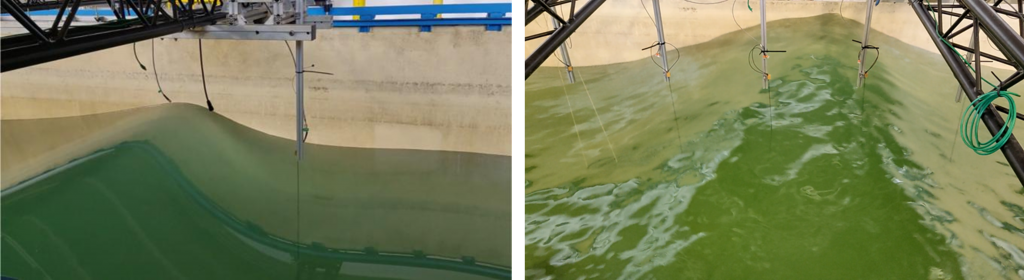
This is the context in which Carbon Wave Gauges emerged, a technological initiative promoted by the companies VTI and ADECUA, combining more than two decades of experience in the design of testing systems and wave generators (VTI) with innovation in custom instrumentation and electronics (ADECUA), whose founder developed the first carbon level probe for salt water.
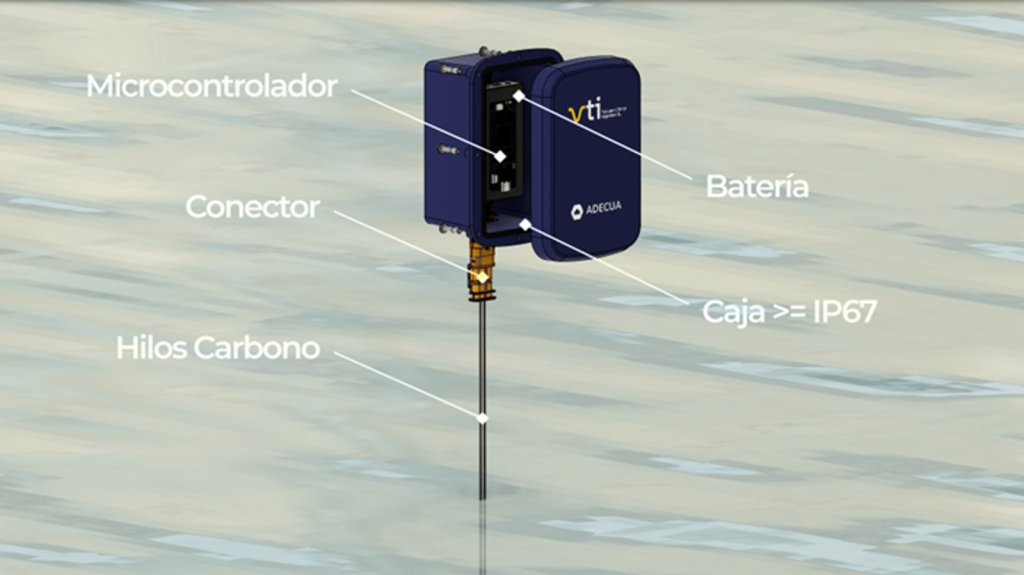
Specifically, the project proposes the development of a new type of carbon fiber-based level and wave sensor, designed for demanding marine environments, with its own electronics and real-time transmission capability. Thanks to innovative measurement technology, the new device will complement the information provided by tide gauges and oceanographic buoys. In addition, new dedicated software, which will include the implementation of artificial intelligence, will improve, among other things, the predictive maintenance of structures exposed to waves before storms. This agile, accurate, economical, and highly versatile form of measurement will improve safety in ports, vessels, and offshore platforms.
At a technical level, the core of the system is a resistive probe made up of parallel carbon fiber strands whose impedance varies depending on the section that is submerged. This solution provides a linear, accurate, and low-maintenance response even in high salinity conditions.
Carbon Wave Gauges has already been validated in the laboratory and in operational environments: linearity, thermal stability, dynamic behavior, and simultaneous use tests in wave generation facilities with up to 25 synchronized sensors. Comparisons with traditional capacitive probes show superior accuracy, reduced drift, and greater robustness in real operating conditions.
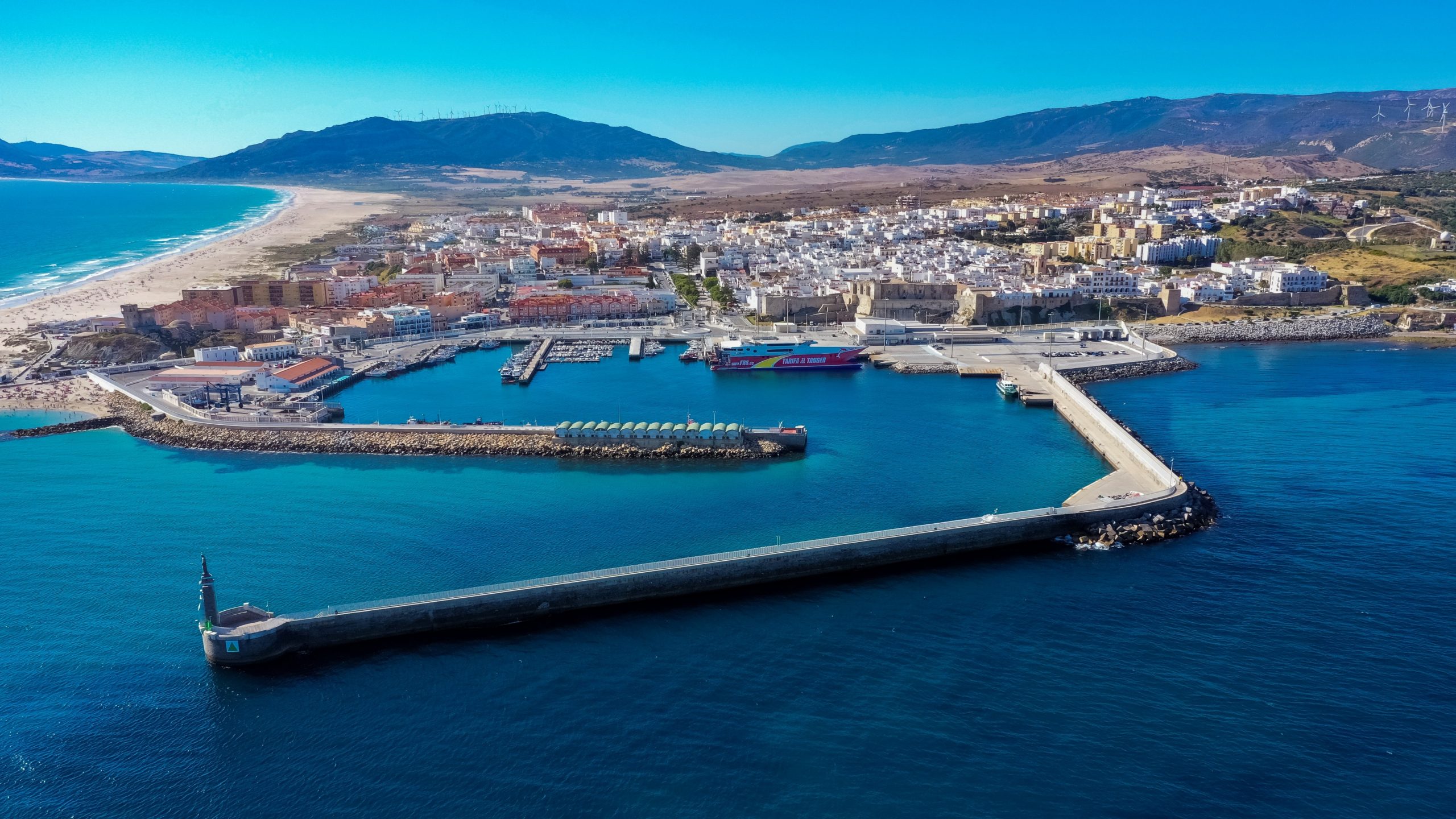
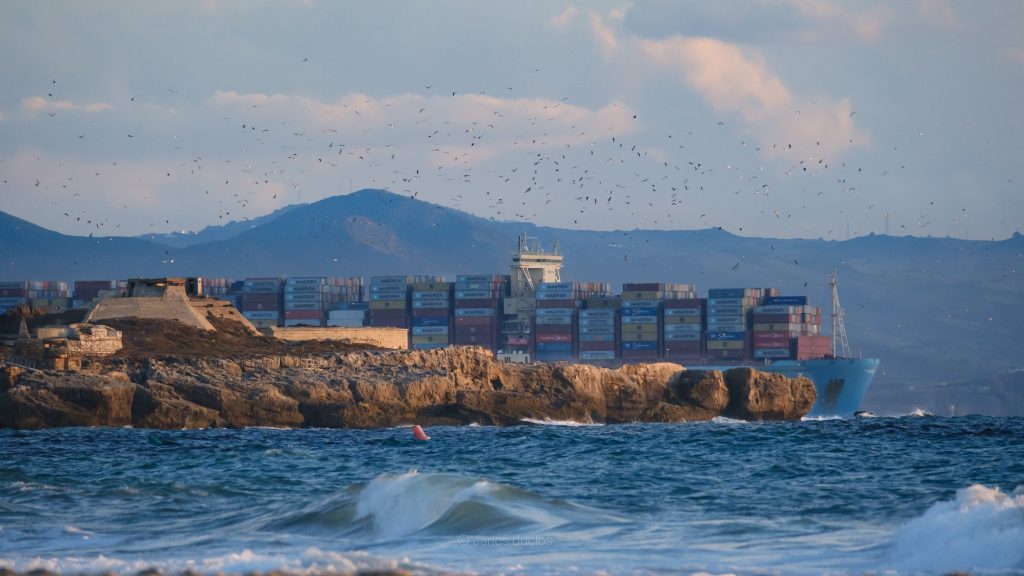
In the next stage, pilot tests will be carried out in a real operating environment, with the aim of validating the performance of the carbon fiber probes in authentic maritime conditions—including waves, currents, salinity, and temperature variations typical of the Strait—and evaluating their integration with the existing technological infrastructure. In this regard, ADECUA and VTI are working together with the Port Authority of the Bay of Algeciras (APBA) to define the test locations, monitoring protocols, and temporary deployment plan, which will allow real data to be collected and analyzed for its usefulness in advanced port applications such as operational forecasting, traffic management, and improved maritime safety.
The project will open the door to multiple applications in the port, oceanographic, and maritime logistics domains: instrumented buoys, research vessels, tide and wave measurement in ports, ballast tank control, wave mapping using drones, and environmental characterization with autonomous IoT systems. In addition, there are plans for the future development of advanced capabilities using artificial intelligence for better real-time wave prediction and integration into sensor networks that are interoperable with digital platforms such as iMar.
This project is funded by the public fund Puertos 4.0 from Puertos del Estado.
Expected results:
- To have a new generation of sea level and wave sensors that are more accurate, robust, and adapted to the saline environment than conventional capacitive probes.
- To obtain real-time measurements of sea conditions, water level, and waves with high linearity and minimal thermal drift.
- Validate the system in port environments through functional tests and technical demonstrations that allow its adoption on an industrial scale to be evaluated.
- Improve operational safety in ports, buoys, and ships through detailed information on waves, tides, and depth profiles.
- Facilitate the implementation of autonomous IoT systems for characterizing the marine environment, integrating wave, meteorological, and physicochemical water parameter data.
- Promote oceanographic research and hydraulic infrastructure design through high-resolution, easily integrated data.
- Enable future dynamic wave mapping with drones, optimizing port entry routes, anchorage selection, and hydrodynamic studies.
- Enable a future interoperable network of carbon sensors connected to national platforms such as iMar.


Leave a Reply