
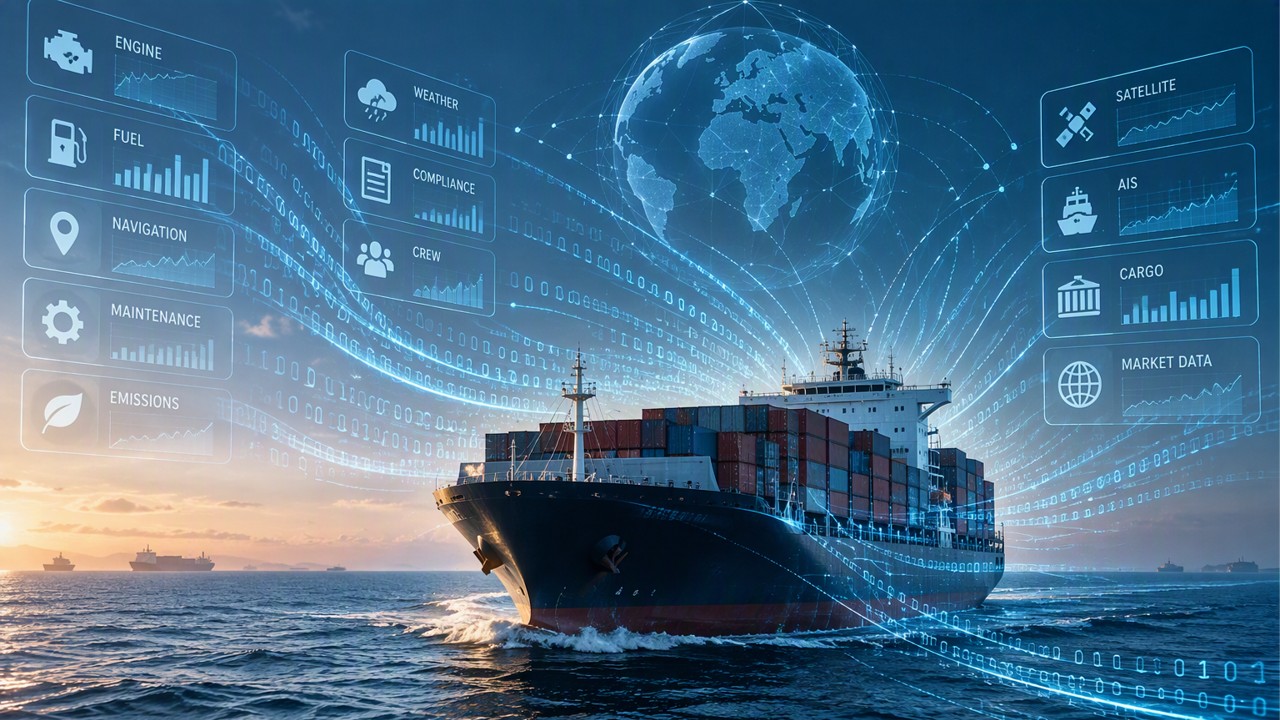
Maritime digital transformation has triggered an explosion in the volume of information available across the industry. Vessels equipped with sensors, intelligent maintenance systems, connected navigation platforms, energy management tools, and AI-powered solutions are generating more data than ever before. Yet having access to more information does not automatically translate into better decisions.
An article featured in the SplashTech Digital Market Report 2026 raises a fundamental question for the industry: how can the growing availability of data be transformed into a genuine competitive advantage?
For years, maritime organizations have pursued a strategy focused on capturing and storing increasing amounts of information. However, the reality is that many companies still struggle to extract tangible value from the data they collect.
According to the article, the next digital frontier is not about generating more information but ensuring that the right data reaches the right people at the right time to support decision-making. Industry experts cited in the report suggest that fewer than 20% of maritime companies currently succeed in operationalizing data effectively and at scale.
The primary challenge is not technological but organizational. Information silos, poor system integration, weak data governance, and limitations in contextualizing operational information continue to hinder progress. As a result, organizations risk making decisions based on incomplete, outdated, or disconnected data that fails to reflect operational reality.
In response, new approaches are emerging based on integrated digital architectures, predictive analytics, artificial intelligence, and advanced visualization capabilities. These technologies enable companies to transform massive volumes of information into faster, more accurate, and business-oriented decisions, ultimately unlocking the true value of digitalization.
“The objective should not be to act on every single data point, but rather to identify which data can drive improvements in decision-making, ensure that it is reliable, and make it available at the right time and within the proper context.”
The main inputs and contributions are:
- The era of big data has reached maturity. The report highlights that data availability is no longer the primary barrier to digital transformation. The challenge is no longer to generate more data, but to develop the organizational and technological capabilities required to exploit it effectively.
- The next stage of digital maturity is about transforming data into operational improvements, cost reductions, resource optimization, and better decision-making. Technology ceases to be an end in itself and becomes a tool focused on delivering business outcomes.
- Most companies in the maritime and port sector, approximately 80%, are still in the early stages of analytical maturity, despite significant investments in digitalization.
- The fragmentation of applications, departments, and databases continues to limit the effective use of information. Interoperability between systems is presented as an essential condition for value creation.
- Data in isolation rarely provides meaningful insight. The report emphasizes the need to contextualize information so that it can be correctly interpreted and effectively used for decision-making.
- The most advanced organizations are evolving towards integrated platforms capable of connecting assets, systems, and processes. These architectures provide end-to-end operational visibility and create a solid foundation for advanced analytics and artificial intelligence.
- The enthusiasm surrounding artificial intelligence should not overshadow a fundamental reality: the quality of its outputs depends directly on the quality of the underlying data. Algorithms can only provide reliable recommendations when working with information that is consistent, up-to-date, and properly governed. AI acts as an amplifier of data value, but it is not a solution to existing data quality issues.
- The availability of advanced dashboards and data visualization tools enables organizations to transform complex volumes of information into actionable insights for operational decision-makers.
- In increasingly dynamic markets, the ability to respond faster than competitors becomes a key differentiator. The report argues that the true value of digitalization lies in accelerating decision-making and reducing response times to operational events, commercial opportunities, and risk situations.
“A modern vessel generates terabytes of data. A smart vessel knows which few megabytes truly matter.”


Leave a Reply